
The James Webb Space Telescope recently observed small objects within the Trapezium cluster that are not associated with any star. These findings could potentially alter existing theories on planet and star formation. The objects, referred to as JuMBOs, have a mass similar to that of Jupiter, a remarkable discovery.
What you should be aware of:
- The telescope discovered a group of objects known as JuMBOS during an examination in the Trapezio cluster.
- Approximately 40 very tiny pairs were seen in total in the Orion Nebula.
- These objects may be linked to theories regarding the creation of planets and stars.
JUMBOs items are located within the Trapézio cluster.
Approximately 40 very tiny pairs were seen in the Orion Nebula, known as JuMBOs, which are not associated with any star. Scientists have yet to clarify their functioning, but it is thought that they were ejected from space due to cosmic events.
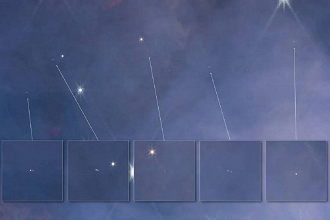
Scientists suggest that these objects may have formed close to stars and then been expelled into space, or may have originated in areas where they couldn’t fully develop into stars. Researchers are currently investigating these scenarios.
Mysterious circular shadows have been discovered around stars in the Orion Nebula, along with the JuMBOs. These shadows are visible in a specific filter and are thought to result from neutral helium absorbing light in the background of the nebula. Researchers find these observations fascinating and have submitted a study on them to a scientific journal.